Their review, on the old app
★★★★★
"Love these! Great product!!!"
Doesn't help the next buyer decide.
Useful review share
Reviews detailed enough to help a shopper decide
Okendo9%
BetterReviews45%
Missouri Star Quilt Company, same customers
Same customer, after a short conversation
★★★★★
"...No afternoon crash like I got with melatonin. Berry taste is actually good."
Use case, comparison, and detail
The founding cohort
First 20
stores get the founding rate, locked for as long as they stay

Most of your reviews don't help anyone buy.

You have thousands of five-star reviews. Shoppers still leave with the same questions: fit, use case, comparison, what surprised them. BetterReviews replaces the blank box with a short conversation that pulls out answers, then white-glove migration from Okendo, Yotpo, Stamped, Loox, and the rest.

Built for Shopify stores doing 5,000+ orders a month.

Used by $10-100M+ stores
Missouri Star Quilt Company Yarn.com

What thin reviews cost you.

Conversions

Shoppers scroll past "Great product!" without self-qualifying. Detailed reviews answer the questions that block the buy.

Returns

Vague praise does not set expectations. Specific reviews tell the right buyer yes and the wrong buyer no before they order.

Team time

Someone is still hunting one-liners for a review worth putting on the store, in an email, or in an ad. That job should not exist.

The hidden ratio

On a $100M+ store, one in ten reviews did any work. Now it's nearly half.

Missouri Star Quilt Company, owned by one of our co-founders, moved from Okendo to BetterReviews. Same customers, same products, same star average. The reviews just stopped being decoration.

Okendo vs BetterReviews on Missouri Star Quilt Company. Same customers, same products.

9% → 45%
reviews detailed enough to help a shopper decide, up 5x
5.3% → 9.8%
reviews that come with a photo, up 1.85x
17 → 38
average words per review, with 2.2x more use cases, comparisons, and specifics
Before · Okendo
★★★★★
"I bought it for part of a gift. I know she'll love it!!!"
A star rating and nothing to decide on.
After · BetterReviews
★★★★★
"I always need this selection in my stash. Our Sewing Bee uses this thread for creating quilts to donate to the local hospital NICU unit. The thread is strong and doesn't break when sewing. It has less lint and there are endless colors to select from."
Verified buyer, collected with BetterReviews on Missouri Star Quilt Company
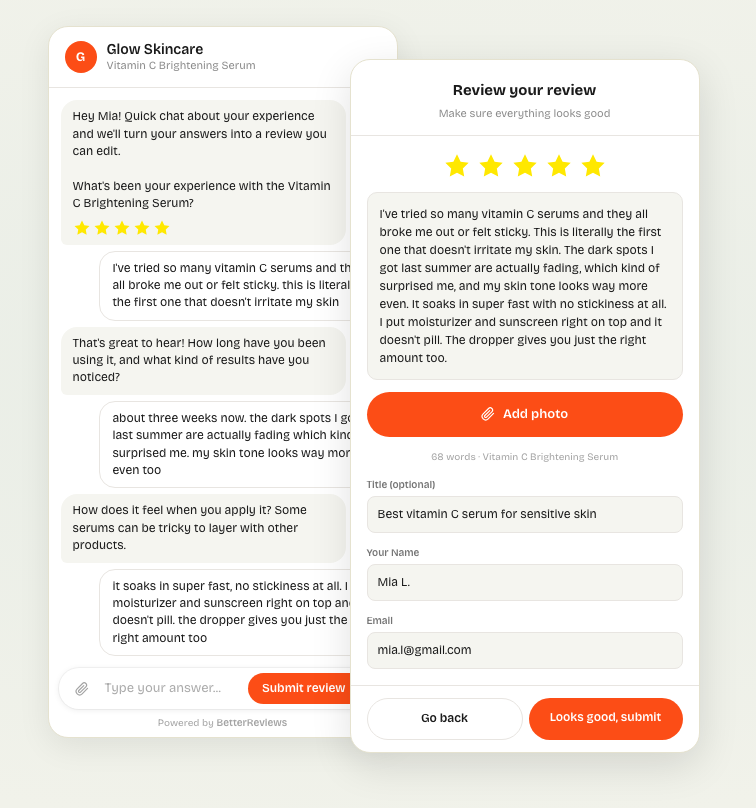
The BetterReviews chat on a phone, next to the finished draft review the customer checks before submitting
The conversation your customer has, and the draft they approve
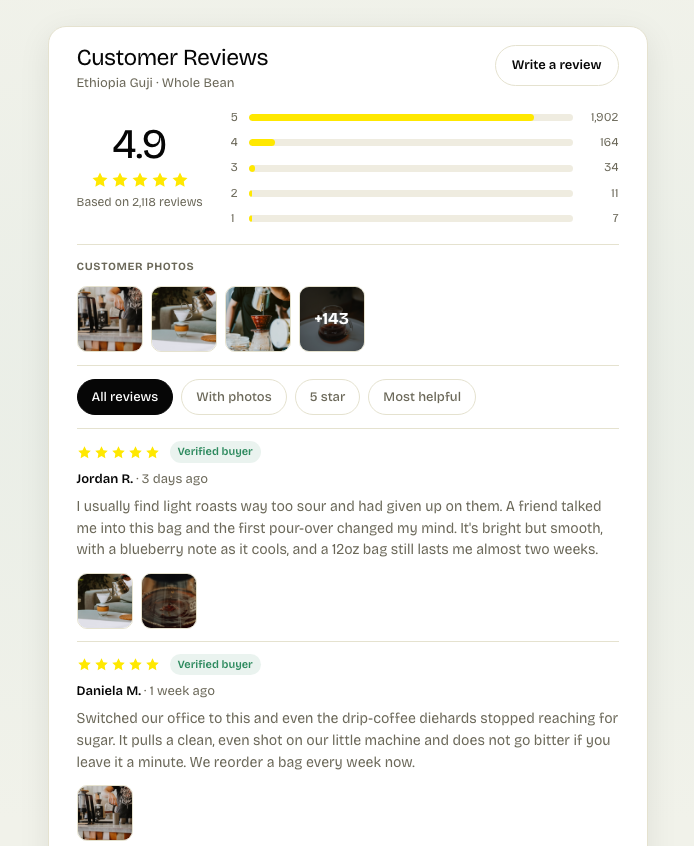
The BetterReviews widget on a Shopify product page, with the rating breakdown, a customer photo gallery, and filters
The widget on your product page, matched to your theme
Why the ratio changes

A blank box collects stars. A conversation collects answers.

A form asks customers to be writers. They leave "Love it." A short chat asks what they used it for, what they compared it to, and what they would tell a friend, one question at a time, already knowing what they bought. Two minutes later you have a review that helps the next person on that product page. The review is built from the customer's own answers, and the customer reads the finished text and approves every word before it publishes.

The blank box gets you
★★★★★
"Love it!"
Social proof. Not a decision aid.
The conversation opens
What was your favorite thing about using this thread?
Always need this selection in my stash.
A form would have stopped here
Then it follows up
What kinds of quilts or sewing projects do you reach for this thread most often?
Our Sewing Bee 🐝 uses this thread for creating quilts to donate to local hospital NICU unit
...what qualities of the Trusty Trio make it the right choice for donation quilts?
Thread is strong - doesn't break when sewing - less lint - endless colors to select from
The review the customer approves
★★★★★
"I always need this selection in my stash. Our Sewing Bee uses this thread for creating quilts to donate to the local hospital NICU unit. The thread is strong and doesn't break when sewing. It has less lint and there are endless colors to select from."
Built from their answers, approved by the customer, then published
Shoppers self-qualify on the product page. Detailed reviews answer fit, use case, and comparison questions that "Great product!" never touches.
Fewer mismatched expectations. Specific reviews set real expectations before purchase, not just star counts after it.
Your team stops hunting. Useful reviews surface in the widget and digest, instead of someone scanning thousands of one-liners by hand.

Customers who just want to leave five stars and go can still do that. Nobody is trapped in a chat.

The product

From the conversation to the product page. See it working.

Why the ratio stays low

Incumbent apps are built to collect volume. Not usefulness.

A 4.8-star average hides the problem. Most platforms optimize for more reviews and more stars. Nobody optimizes for whether the text helps someone buy.

Door one. Pay more every time you grow.

Okendo$119 to $499by order volume; ~2x top-up rates over cap during Black Friday
Yotpoaround $269 to $469slides with orders; one documented renewal came back 78% higher
Stamped$99 to $199counts every order; review request emails stop when the order cap is hit
Loox$49.99 to $999.99$50 per 300-order block; marketplace orders counted too
REVIEWS.io$299annual billing, ~25% more monthly, priced per domain

You pay enterprise prices to collect one-liners at scale.

Door two. Pay less and lose the person.

Judge.me is $15 with no order caps, and for a small store it is the best deal on the app store, plainly said. It works because it serves around 700,000 stores, and at that scale personal attention cannot be part of the deal. No one opens your dashboard, watches your response rate, or tells you what to change. That part becomes your job.

Cheap collection. Same blank box. Same thin reviews.

Okendo gives you an account manager. Judge.me gives you a ticket queue. We give you conversations that change what customers write, and a founder who tunes them for your catalog.

How this works

Done for you. Tuned for your catalog.

Generic review forms produce generic reviews. BetterReviews ran a $100M store before it took a single outside customer, and the first 20 stores from outside join as the founding cohort: every one known for its catalog, send timing, and history. Your subscription funds no sales team, no support tiers, and no account manager inherits your store on a Tuesday.

Setup, done for you

You get the widget installed and matched to your theme, and review request timing built around how your products actually ship. No checklist, no docs link.

Migration, done for you

Every review, photo, and star rating moves over by hand, counted against your old platform before you cancel anything.

A monthly read on your dashboard

Whether new reviews are helping shoppers decide, and what to change if they are not. Same person every month, specific changes to make.

Answers from someone who knows your store

The same person every time, one who already knows your catalog and your customers. Or just email Daniel directly: [email protected].

We built a reviews app that helps people buy

We previously ran reviews for a $100M Shopify store on Okendo. Same customers, same products, same stars, and most of the text still did no work on the product page. After we fixed that for ourselves, we built BetterReviews for the next twenty stores that refuse to treat reviews as wallpaper.

The founding cohort gets a full reviews stack tuned for usefulness, not volume: AI-guided collection, white-glove migration, a widget that matches your theme, and a monthly read from someone who already knows your catalog. As a founder-run, bootstrapped company, we can offer you:

  • Reviews detailed enough to help a shopper decide
  • Flat pricing that never counts your orders
  • A person who knows your store, not a ticket queue

Orders and emails are never counted. The useful share is the thing we optimize, and the thing we guarantee.

Proudly built in Warsaw 🇵🇱

Daniel Studzinski Co-founder, BetterReviews
Included

Unlimited collection. A higher share that actually helps.

Unlimited orders

Orders are never counted. Growth does not change your base plan price.

Unlimited reviews

Collect and display as many as you can get.

Unlimited review request emails

Send to every order, every time, with your own timing.

Price locked at signup

The price you sign up at is the price you pay for as long as you stay. If prices go up for new stores, yours does not move.

  • Review widget that matches your theme, positioned wherever you want it in the theme editor
  • Star ratings in Google search results and Google Shopping
  • Review request emails with your branding and per-product timing
  • Photo and video reviews
  • 1,000 AI-collected reviews included every month; past that, customers get the classic form, or Fair auto-recharge tops you up under a monthly cap you set
  • Automatic review analysis that flags spam, routes support-shaped messages to your team, and surfaces your most specific reviews
  • Import from Okendo, Judge.me, or a CSV out of anything else
  • Full export of your data, any time, no questions
  • Q&A, review moderation, and a weekly digest of what came in
Founding cohort

One plan. A person who knows your store.

For stores doing 5,000+ orders a month. Flat monthly price. Price locked at signup.

Orders, reviews and emails are unlimited. AI conversations: 1,000 included on Founder. Past that, classic form free, or Fair auto-recharge on AI-guided reviews under your cap.

90-day outcome guarantee

If your reviews are not materially more useful at 90 days, those months are free: credited on your Shopify bill.

Details in the FAQ: useful-share rubric, week-one baseline, volume guardrail, and one schema carve-out.

Flat price, locked at signup. Orders, reviews and emails are unlimited. AI conversations: 1,000 included; a credit is used only when a customer actually submits an AI-guided review. Past that, classic form free, or Fair auto-recharge adds 500 more for $50 under a monthly cap you set. 14-day free trial. Switching? The side-by-side switch runs free: if migration outlasts the trial, the extra time is on us.

Competitor prices on this page are from their public Shopify App Store listings, checked 19 August 2026. Yotpo does not publish a list price, so those figures are approximate. Renewal increases, top-up rates, and what happens at an order cap are as described in published merchant reports and vendor documentation, not from our own billing data.

Migration

You do not cancel anything until it is proven.

The reason merchants stay on a reviews app they dislike is the switch. Losing reviews. Losing Google stars. Paying two bills. You do not rip Okendo out on day one. You run side by side until the numbers and the stars are proven.

01

Side by side, free

BetterReviews sits alongside your current app while everything moves across. The standard trial is 14 days, and if the switch needs longer, tell Daniel: the extra time is on us.

02

Migration, done for you

No import wizard for you to babysit. A person moves the reviews, the photos, the ratings, and the verified buyer status across by hand, and helps wire Google and Meta review feeds during white-glove migration.

03

Count-match report

Reviews in on the old platform, reviews out on the new one, per product, side by side. Any number that does not match gets chased down before anything else moves, by the same person doing the move.

04

Google stars verified

Your product pages get run through Google's own testing tools until the stars read from BetterReviews. You keep the old app running until that check passes.

05

Pay at go-live

Billing starts when the widget goes live on your storefront. Not at signup. Not when the trial ends. When your customers can actually see it.

Most stores start with a slice: keep Okendo live, put BetterReviews on a few SKUs, and make sure only one app emits review schema on any given PDP. Before anyone cancels, we track whether new reviews answer the questions shoppers ask on your product pages, and whether published reviews per 1,000 orders hold.

Questions

Before you claim a seat.

Will I lose my Google star ratings?

No, and it does not run on trust. Your old app keeps running while both are live. Before you cancel anything, your product pages get checked in Google's own testing tools to confirm the stars are being read from BetterReviews. Only then do you turn the old one off. Google stars are the thing merchants are most scared of losing in a switch, so it is the last thing touched and the one thing verified out loud.

Can I bring my existing reviews?

Yes, and they get moved for you. Import from Okendo, Judge.me, or a CSV out of Yotpo, Loox, Stamped, REVIEWS.io, or anything else. Reviews, photos, star ratings, dates, and verified buyer status all come across. A co-founder's store came off Okendo with 306,000 of them intact. You get a count-match report per product so you can see nothing went missing.

We already have thousands of reviews. Why would we switch?

Because volume is not the problem. On most stores we audit, the vast majority of five-star text does not help a shopper decide. You are not starting over: you import everything, run side by side, and measure whether new reviews are more useful than what the old app collected.

What about Klaviyo, Google, and Meta?

Klaviyo: yes. Review events can power your flows the way they do today. Google Shopping stars and Meta catalog ratings: we provide an uploadable feed, and we help wire it during white-glove migration so you are not left figuring out the file alone. We are building 20+ more integrations right now and will ship them soon; until then, the side-by-side switch means your current Okendo surfaces can stay live while we cover the critical path.

Why only 20 stores?

Because every store here gets known: its catalog, its send timing, its history. Twenty is the number where that stays true, and it means yours is never a ticket number. Any more and $99 buys you a login and a help doc, which you can already get elsewhere. The founding twenty also get the most say: what you ask for goes straight to the person who writes the code, and at this size there is no roadmap committee in between. The cap exists so the promise stays true, and the cap is the reason the price works. And if you are mid-evaluation when the cohort fills, your seat holds. A count should never rush your diligence.

I'm on Judge.me and happy with it. Should I switch?

Probably not. Judge.me at $15 with no order caps is the best deal on the Shopify app store, and if it is working for you, stay. This is built for stores that have outgrown that setup: brands where reviews should help shoppers decide on the product page, and where a shallow review corpus is costing real money. If that is not you yet, keep your $15 and come back when it is.

What does "price locked at signup" actually mean?

The monthly price you sign up at is the price you pay for as long as your subscription runs. The founding rate is $99; stores that join after the first 20 pay the $149 list price, and their rate is locked too. No annual uplift, no renewal increase, no repricing when you grow. Orders and review request emails are never counted. AI-guided reviews have a monthly included allotment; past that, classic form stays free, or Fair auto-recharge under a cap you set.

Is there a catch on "unlimited"?

Orders, reviews, and review request emails are unlimited: never counted, never capped, never silently stopped. AI conversations: 1,000 included a month on Founder, and a credit is used only when a customer actually submits an AI-guided review, never for starting a chat. Past that, classic form free forever so collection never stops, or Fair auto-recharge on AI-guided reviews under a monthly cap you set (500 for $50, with the first 50 over free).

Is the review text really the customer's own words?

Yes, and there is a hard gate that keeps it that way. The chat asks questions, the review is drafted from the customer's own answers in their own phrasing, and the customer then reads the finished text and edits or approves it before anything publishes. Nothing posts without their sign-off, and you moderate as usual on top of that. This matters beyond quality: Google's product-rating rules and the FTC's consumer review rule both expect reviews to be the reviewer's genuine words, and the approval step is what keeps every published review exactly that.

Do negative reviews still publish?

Yes. Unhappy customers are not diverted away from leaving a public review. AI moderation can flag spam and route support-shaped messages to your team, but that is flagging and routing, not gating. A real negative review publishes like any other, subject to the same customer approval step and your normal moderation.

How does billing work?

Through Shopify's own billing system. The charge sits on your Shopify invoice, uninstalling cancels it, and Shopify's billing protections apply. That is also what makes the price lock more than a promise on a page: changing your price would require a new subscription that you would have to explicitly approve in your Shopify admin. The lock is enforced by how Shopify billing works, not by trust.

Where does my customers' data go?

Review conversations are processed by an AI provider under a data processing agreement, and that is the only thing the AI touches. Customer personal details are encrypted at rest, email lookups run on hashes rather than plaintext, and deletion requests cascade through everything, as required by Shopify's protected customer data rules. The chat transcript is retained as an audit trail of what the customer said and approved. The subprocessor list is short and available on request, and your data exports belong to you at all times.

Will customers actually answer questions instead of leaving stars?

Yes, and if they do not want to, they can leave a rating and go. The chat is short, it is on their phone, and it already knows what they bought so it never asks them to remember. On the co-founder's store running it in production: about seven in ten customers who answer the first question go on to submit a finished review. Average review length went from 17 words to 38, and the share detailed enough to help a shopper decide went from 9% to 45%. We also track published reviews per 1,000 orders against your old app before anyone cancels. Word count is supporting evidence; usefulness on the product page is the quality bar.

You are one person. What happens if you disappear?

Fair question. First, the exit is always open: your reviews are yours, and you can export all of them at any time in a format any other platform will take. Nothing is held hostage. Second, BetterReviews is funded by the merchants who use it, with no investors and no pressure to sell or pivot. Third, day to day you deal with one person, but you are not hanging off one calendar: a dedicated on-call engineer covers when Daniel is away, and during Black Friday Daniel is on. Fourth, a co-founder's $100M store runs its reviews on this platform: skin in the game, not a guarantee of immortality. Fifth, if BetterReviews ever grows past what one person can serve, the intake cap changes for new stores; the promise to existing stores does not.

What does the 90-day outcome guarantee cover?

If your reviews are not materially more useful at 90 days, those months are free (credited on your Shopify bill). In practice: usefulness of reviews collected via AI conversations, not classic-form overflow and not length alone. The bar is at least 15 percentage points higher than your pre-switch baseline. Baseline and day-90 scores use the same short written rubric (use case, comparison, or concrete detail), scored with you in week one. You can challenge a sample and we reconcile before any credit. We also watch published reviews per 1,000 orders so collection does not quietly collapse. One carve-out: only one app emits review schema per PDP.

The founding cohort

The first 20 stores get the founding rate and never become a ticket number.

Reviews that help people buy, not just star counts. A person who knows your store. Side-by-side migration until Google stars are verified. Founding rate $99, locked; $149 after the first 20. And if your reviews are not materially more useful at 90 days, those months are free.

Free while you switch. Price locked at signup. Full export any time. Questions? Email Daniel directly: [email protected]